More on the Project
The Dead Space Project Addresses Many Issues
The early Creole above-ground cemeteries of New Orleans, long appreciated and promoted as historic sites, as well as traditional burial places, are currently experiencing renewed popularity through heritage tourism. Yet with this revived interest, have come commercialization, overzealous restoration and opportunistic vandalism, in addition to existing neglect and abandonment. As a result, many of these sites are now at serious risk through loss of physical integrity and historical character, as well as changing social and cultural contexts.
A 2-phase documentation and conservation project focused on St. Louis Cemetery No. 1 was developed by the University of Pennsylvania’s Graduate School of Fine Arts Departments of Historic Preservation and Landscape Architecture with Tulane University’s School of Architecture/Preservation Studies in conjunction with Save our Cemeteries, Inc. and the Roman Catholic Church of the Archdiocese of New Orleans. Funding was provided by grants from the Louisiana Division of Historic Preservation, Office of Cultural Development, and the Samuel H. Kress Foundation.
A model conservation plan was developed through the documentation, recordation and analysis of this urban cemetery landscape and its context through time. This was realized through visual mapping and surveys of the cemetery, coupled with the development of practical conservation guidelines for the care and maintenance of these unusual necrogeographies and their features (e.g., tombs, paths, vegetation, etc.) To accurately document this site, historical changes in boundaries, design and use were critical elements to capture and visually portray. Central to the project has been the utilization of digital technology to link archival maps, images and text with current field survey information in a robust database, coupled with Geographic Information System (GIS) mapping to provide descriptive and analytical tools for communication, decision-making and management. Today, these results are in use by professionals and community members as they make decisions and guide the conservation efforts funded by a separate “Save America’s Treasures” grant.
By focusing on the immediate practical and long-range management issues of these unique sites, it is hoped that other less obvious but no less important considerations responsible for the creation and evolution of these places can be addressed. Through the benefits of a multi-disciplinary approach and the use of GIS, various aspects of the cemetery have been explored including the physical evolution of the site over time and the mapping of cultural influences (Spanish, French, Anglo-American, African) on tomb location, type and style. Existing conditions and treatment recommendations have been studied through the construction and manipulation of relational datasets. Also addressed is the role of past invented histories and tourist development in the decline and revival of New Orleans’ historic cemeteries. Such concerns are related to the larger cultural questions of the ‘construction of identity’ and the ‘invention of tradition’ which have been of interest to public historians, anthropologists, and preservationists in understanding people’s changing relationships to specific sites. For preservation, these issues beg renewed consideration of such places as social constructs, rather than only as designed entities, both necessary for the continued use and preservation of these places as unique culturally-defining elements for New Orleans and the region.
The Survey
In 1981, a full survey of St. Louis 1 Cemetery was made by Save Our Cemeteries, Inc., and all documentation was housed at The Historic New Orleans Collection (THNOC). The surveyors documented all tablet locations and inscriptions, names, and dates. Minimal information was collected on the materials of construction, decoration, and tomb condition. Each tomb was photographed. Tombs were numbered generally according to an earlier hand-drawn survey map from the Archdiocese and were cross-referenced to an older Archdiocese numbering system that locates tombs by their street or alley address.
After reviewing various models of surveys used for other cultural landscapes and cemeteries, a pilot survey form was developed and the development group prepared a field manual to assist and aid in the use of the survey on site. The manual covered all sections of the physical survey including identification, environment, description, condition (masonry), landscape, and metals. While the survey form and manual were developed for the St. Louis Cemetery No. 1 survey, they are meant to serve as models for future cemetery and burial ground surveys.1
Download Illustrated Manual
The purpose of providing a manual for participants in the survey was twofold. First, it contained clear guidelines as to how the survey form was to be completed, thereby controlling the process in which the data was collected. It was necessary that elements and conditions were accounted for in a uniform and controlled manner in order to accurately map the information and analyze the data by querying the database. Second, the manual provided a specific definition and complete explanation for each item in the survey. To supply further clarification for certain items on the survey, such as tomb type and planting materials, illustrations or photographs accompanied the definitions. By providing a manual to those involved, the survey team hoped to ensure accurate observations in the field and to record standardized, uniform results.
Before the site visit, historical images and references to landscape features were collected and analyzed. On site, a complete inventory of the current features, vegetation, ground covers, path materials, drains, and individuation plantings was taken. Further topographic mapping information was collected and all interior and exterior paths and sidewalks were surveyed. Each tomb or marker was surveyed for location and placement, typology and features, condition and integrity. All tombs, markers and landscape features were photographed and key areas were further documented with measured drawings.
To help participants locate the tombs within the cemetery, each tomb on the original Archdiocese map was numbered. A grid was superimposed over the entire cemetery and assigned alphanumeric designations. The cemetery was divided into 25 sections, with 30 tombs per section. Each surveyor was assigned one section. During the week of March 10, 2001, each surveyor completed his or her assigned survey section. In October, 2001, after an analysis of the March results, a team of 4 field-checked the entire survey particularly for condition and integrity ratings and added additional clarification to notes on construction and additions.
Creating, organizing, and implementing a physical survey of the over 700 tombs and markers at St. Louis 1 Cemetery was itself a challenging undertaking. However, in terms of the overall objectives of the Collaborative Studio, the survey was only the beginning. The information gathered was entered into a Microsoft Access® 2000 database then into Arc View® 3.2, a geographic information system, where data could be plotted and analyzed through spatial mapping.
- Work referenced included: Earlier St. Louis Cemetery No. 1 and 2 surveys, Lafeyette Cemetery No. 1, New Orleans, LA; The Center Church Crypt, Temple Street, New Haven, CT; Colonial Park Cemetery, Savannah, GA; King’s Chapel Burying Ground and Granary Burying Ground, Boston, MA; Old Swedes’ Burying Ground, Wilmington, DE; Trinity Episcopal Cathedral Burying Ground, Pittsburgh, PA; Trinity and St. Paul’s Churchyards, New York, NY; Congressional Cemetery, Cenotaph Survey, Washington, DC; and The Protestant Cemetery, Rome, Italy; plus Bandelier National Monument, Los Alamos, NM and Mesa Verde National Park, Mesa Verde, CO Condition Assessments. Other publications consulted included: Massachusetts Department of Environmental Management, Preservation Guidelines for Municipally Owned Historic Burial Grounds and Cemeteries (Boston, MA); Canadian Ministry of Citizenship, Culture and Recreation, Landscape of Memories: A Guide for Conserving Historic Cemeteries (Canada); English Heritage, Stonehenge World Heritage Site Management Plan (England); Matero, Frank G. New Orleans Historic Cemetery Conservation Program. (LA State Historic Preservation Office, 1987); Historic Tallahassee Preservation Board, Historic Cemetery Preservation Handbook (Tallahassee, FL); Matero, Frank G. “Toward a Methodology for the Conservation of Historic Burying Grounds and Funerary Monuments.” Annual Conference of the Association for Preservation Technology, (1991); Matero, Frank G. The Conservation of Historic Funerary Monuments and Burying Grounds, (The Connecticut Trust for Historic Preservation, 1988).
Recommendations
Any attempt at preserving an object, building, or site invariably causes a disruption in the natural life cycle of the subject. St Louis 1 Cemetery is a living, dynamic place with many historical uses, meanings, and appearances that must be understood to be stewarded properly. The cemetery should be encouraged to continue in its historical roles as an active place of burial and family visitation, as well as a tourist destination and a place for contemplation. Future changes to facilitate these uses, and to conserve the physical fabric, should be planned and managed to preserve and enhance the character of the site.
St. Louis 1 Cemetery was not originally intended to be viewed as a collection of decayed tombs. However, over time, the cemetery, like many such sites, has become defined by, and admired for, its picturesque decay. Indeed, much of its past and current appeal is tied to this aspect of age. Decay and age are essential components of the site. However, these components must be counteracted by sensitive and timely repair and maintenance.
During this project, appropriate maintenance, repair and restoration methods have been tested and implemented on pilot tombs and on the tombs of Alley 9-L St. Louis Cemetery No. 1 Guidelines for Preservation & Restoration has been prepared and can be downloaded from this site. We recommend repair techniques and cycles that are maintainable and sympathetic with the existing materials. In addition, we believe that some level of aesthetic restrictions should be placed on this site, just as is often appropriate for significant historic districts, to attempt to prevent jarring changes, and to ensure long-term sustainability of this fragile cultural landscape.
Two material changes in the past thirty years highlight the aesthetic issues; the substitution of blue granite as a closure tablet for white marble and the liberal use of concrete for roofs and pavements and full replacement of tombs of historic value.
Marble Tablet Replacement Issue
Marble tablet deformation is the result of dimensional under sizing (thickness), unsupported installation, climate, and material. While all of these factors cannot be easily remedied, such as climate, increasing the thickness of the slabs to 1¼ – 1 ½” would dramatically improve marble tablet rigidity. Substituting other varieties of white marble (for the original Carrara), that are less prone to bowing, would be preferable to using the popular and widely available dark gray granite and anorthosite.
These granite closure tablet replacements are dramatically different both in color and reflectivity from their marble precedents. Their widespread use is significantly impacting the appearance of the site as a whole. Surface finish samples show that historically, the tombs were white-washed or colored red, yellow, or grey. Currently, most painting has been with modern white latex-based materials. Tomb colors are now inverted: white tombs with colored tablets are appearing. While the closure tablet issue may seem like a minor aesthetic debate, it is indicative of the larger question of the contribution of repetitive architectural elements to the visual integration of the overall site and the impact of such changes.
Replacement also encourages loss of critical information if tablets are not remounted on the tomb. Remedial methods to repair and reinforce tablets for reuse do exist, and have been demonstrated throughout this project.
Concrete Roofs, Precincts and Tombs
The issue of the poured-in-place concrete roofs and precincts is another instance of a decision that may have seemed logical given the information that had been provided to the Archdiocese on an individual tomb basis, but the impact on the tombs and on the site as a whole has been dramatic, as the practice has become widespread.
Over the past thirty years, concrete roofs and pads have been installed on many of the tombs, presumably to stop moisture penetration and, possibly, to aid against subsidence. As a result of this individual tomb work, architectural details (e.g. cornices) are being lost and the site is now being slowly covered in concrete in the name of tomb preservation. More research is needed, but it is likely that this practice is actually causing greater moisture retention by forcing more rising damp up into the soft brick of the individual tombs, or in the case of the roofs, entrapping existing water inside. Increased moisture will soften brick and mortar and if allowed to cycle through wet and dry states, will cause serious structural problems. This may take time to evidence because the tombs are also receiving hard, dense cement stuccos, further locking in rising damp and concealing the growing structural failure problems. Poured concrete roofs are also significantly heavier and may lead to accelerated subsidence of the tomb.
Even more disturbing is the complete destruction of the historic tombs. In an effort to clean up the ruins and the site as a whole, cemetery management has been recommending that tombs be placed in the Perpetual Care program. The restoration answer for many tombs in Perpetual Care has been to dismantle them and replace them with concrete shells and the dark closure tablet. With the success of this Save America’s Treasures project, there are now proven alternatives. These significant historic resources can be preserved according to the Secretary of the Interior’s Guidelines, by local masons and as cost effectively as the concrete shell approach.
Landscape Recommendations
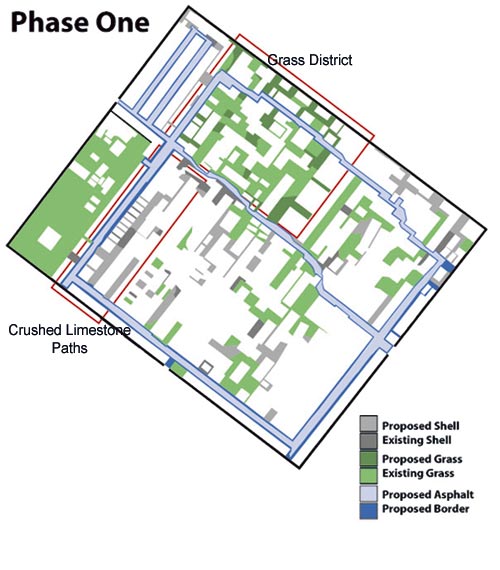
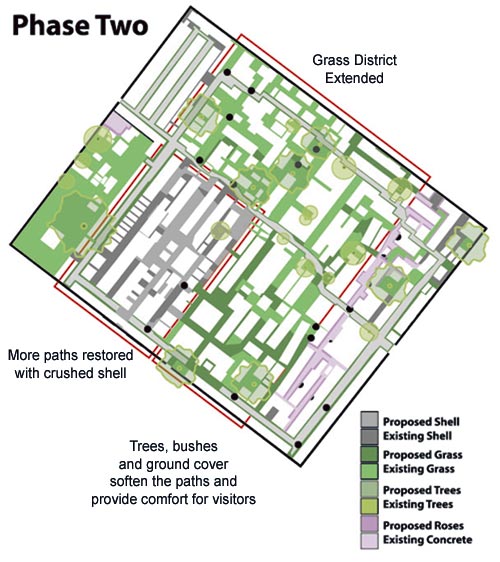
After evaluating the existing site-wide landscape conditions, recommendations were developed that can be broken down over a ten-year time span. These recommendations address the immediate needs of the site, revitalize the landscape and continue to underscore the historic elements so pertinent to St. Louis 1 Cemetery. The work in several phases can be initiated over time as funds and volunteers are available.
Historically, shell was the primary path material and was also the primary ground covering between tombs within the rows. While oyster shell is no longer available due to environmental concerns, we recommend that all exposed soil paths and patches across the cemetery be converted to a crushed limestone surface. This path treatment has been successfully impemented in the Alley 9-L tombscape restoration.
A grass district in the northeast area of the cemetery is also recommended. In this district, the only ground surface material will be grass, including those areas now used as paths between the tomb rows. To better control and direct large groups of visitors, a new hard surface path should be created as the primary circulatory loop of the site. This path currently exists in asphalt along Alley No. 1L, 1R, 8, 9, and 10 R, Center, Conti and St. Louis Alleys. Vinca, Helix and Thyme ground cover edging should be planted to line the path. If possible, a new aggregated surface material similar in appearance to shell should be installed. The increased use of historic and substitute paving materials, with increased permeability, will add efficient water absorption while maximizing the irrigation needs of the existing plants. Where the hard concrete paths cannot be replaced, they can be softened with a proposed ground cover edge of Memorial Rose species (Rosa wichuraiana).
A variety of evergreen and deciduous trees and shrub species are proposed to include Quercus agrifolia, Magnolia grandiflora, Magnolia soulangiana, Lagerstroemia indica, Phoenix spp., Gardenia jasminoides, Rhodeodendron spp., Azaleas spp., and various annuals indigenous to New Orleans. The overall ambient temperature experienced on site is greatly reduced with improved canopy coverage from large evergreen shade trees and ground cover vegetation and would greatly improve visitor conditions.
More archival work is needed to fully develop recommendations for the restoration of the individual tomb gardens. Used for both visual and olfactory decoration of the tomb and cemetery as a whole, gardens played an important role in the design of the tomb, and specialized plant pallets encoded with the language of mourning were used as part of this design.
Early photographs of the cemetery show a wide scale presence of plantings, sometimes formally presented in beds, sometimes with a more informal relationship to specific tombs, sometimes with little or no relationship to any single tomb. Trees and shrubs were not uncommon in the cemetery, breaking the hard, urban quality of the cemetery with a combination of indigenous and exotic trees and shrubs. As future tomb restoration projects proceed, archival research should include a study of the historic plantings and family practices of adorning the tomb, so that these tomb gardens can be restored.
Maintenance
By the end of the nineteenth century, St. Louis Cemetery No. 1 had fallen out of favor as New Orleans residents moved out to the more fashionable cemeteries of Lafayette and Metairie. As interment activity fell, so did visitation and family maintenance activities. Grace King, the noted New Orleans historian, wrote in 1895 of a cemetery that was no longer open to visitors:
The crumbling bricks of the first resting places built there are still to be seen, … It opens its gates only at the knock of an heir, so to speak; gives harbourage only to those who can claim a resting place by the side of an ancestor. 1
The true root cause for the deterioration results seen at St. Louis Cemetery No. 1 is a lack of cyclical maintenance and timely periodic repair. The weathering and ageing of porous building materials is to be expected. The surface finishes and stucco layers were applied as sacrificial finishes to protect the interior structural elements. Webster’s unabridged dictionary defines sacrificial as “relating to sacrifice, the destruction or surrender of something for the sake of something else; giving up of some desirable thing in behalf of a higher object.” In building materials, sacrificial implies impermanence, and the original intent was that the sacrificial finishes, both stucco and lime washes, would be replaced more frequently that the structural body when their effectiveness became reduced.2
Today, there is new interest in the maintenance and restoration of this historic cemetery. Family members and volunteers can all be involved.
- Limewashing
- Crack Repairs & Periodic Reapplication of Stucco
- Cleaning Marble Tablets & Sculpture
- Vegetation & Landscape Issues
- Grace King, New Orleans: The Place and The People, (New York: Macmillan and Co., 1895), 401.
- Judith A. Peters, “Modeling of Tomb Decay at St. Louis Cemetery No. 1: The Role of Material Properties and the Environment,” Masters thesis, University of Pennsylvania, Aug. 2002, 208.
Save America’s Treasures
In 2001, St. Louis Cemetery No. 1 was nominated to the Save America’s Treasures (SAT) program and has recently received unprecedented funding to begin preservation work. The current Save America’s Treasures program has three major objectives:
The SAT project is under the direction of Frank Matero, University of Pennsylvania, Ann Masson, Assistant Director, and Dorothy Krotzer, supervising conservator. The SAT project team includes Laura Ewen, Lindsay Hannah, Heather Knight, and Sophie Middlebrook, conservation assistants; Pietro Mangarella and Kecia Fong, conservators; Royal Osborne, Raphael Perrault masons; Anthony Henderson, Patricia Hulin, and Jim Jenkins, artisans; Laurence Saltzman, documentary photographer and Judy Peters, Architectural Conservation Research Center support.
Emergency Stabilization – The SAT program addresses those tombs in the poorest condition in the hopes of stopping further deterioration until additional preservation funds become available. Thirty-five tombs have been identified for emergency stabilization based on the earlier survey. Most emergency work includes the repair and closure of open roofs. This work requires both traditional masonry techniques and specialized preservation knowledge. Typical emergency stabilization work includes cleaning the debris and vegetation from tomb roofs and relaying and replacing bricks in a soft traditional lime mortar as originally constructed. All tombs are carefully studied and documented prior to stabilization and occasionally construction details are changed for better durability.
Tombscape Restoration – Alley 9-L was selected as a candidate for restoration of a representative cemetery “tombscape” because of the degree of material and structural integrity that remains in this particular alley of the cemetery. In addition, there are historical images (mainly photographs) of Alley 9-L that document its appearance throughout the nineteenth and twentieth centuries. The alley also retains its much of its shell and dirt path. The thirty-one tombs on this alley have been documented and fully or partially restored by the SAT Conservation Team and contracted local craftspeople, following the model of the three pilot tombs restored by Save Our Cemeteries last year (Esteve, Bergamini and Perrault).
By coordinating the knowledge and skills of many specialists to develop and implement a conservation plan for St. Louis Cemetery No. 1, this multi-faceted project provides an alternative approach to the long-term preservation and care of a very unique and important American place. The results of all phases of the project may be accessed here on this website, the Save Our Cemeteries, Inc. website, www.saveourcemeteries.org, and through articles in Preservation in Print, an award-winning journal published by Preservation Resource Center of New Orleans and the Louisiana State Historic Preservation Office.
9-L Tombscape
The tombscape is in many ways akin to the historic district, pulling from a variety of sources to create a context that is both self-defined and often part of a greater context, in this case, a cultural landscape.
The memorial function of the cemetery’s tombscape, however, gives it a context of a unique character beyond the historic district, reflecting an approach to design that, in addition to its practical functions, seeks to order the incomprehensible phenomenon of death. The reasoned application of classical decorative modes and orthogonal path planning has become disoriented in its dealings with death, and what results is the tombscape, a dynamic jumble of form, space, and context. The tombscapes in the St. Louis 1 Cemetery are varied according to their associated tombs, their views, and their placement within the cemetery.
Alley Number 9-L is a section of the cemetery that illustrates a tombscape with more intimate proportions and a more traditional alley form. Capped on its end by the Marigny Tomb, Alley No. 9-L runs east/west and spans the distance between Conti Alley and Center Alley. Its diversity of tombs, in type, age and size gives it a richness characteristic of the cemetery in general, and illustrates the cumulative meaning of the tombs, which, when seen as a group, is greater than the significance of the tombs as separate entities. Some tombs are commonly seen as more culturally significant in the group, such as the de Marigny Tomb and the French Society Tomb, but the notion of the tombscape recognizes the phenomenological impact of the tombs together, whose individual material, spatial, and cultural features are informed by and participate within the greater context of the group. This context extends beyond the group of tombs to include views and viewsheds that form the tombscape as well. The collage below shows a view of this alley looking southwest toward the de Marigny tomb.
Because of the high degree of integrity of its various components, this alley has been chosen to serve as a model for tombscape restoration. The tombscape restoration / maintenance process is being funded by Save America’s Treasures.
To initially schedule the alley’s complexity into phases of work, the database and GIS maps were used to classify tombs according to their condition and integrity. Once Alley number 9-L was pulled from the master map of the cemetery, the conditions coded in the GIS map were compared with site notes and photographs to verify the accuracy of the survey and to look for conditions which might fall outside of the quantifiable factors described in the database. A final list of activities for each phase was compiled with changes to be made in the individual tombs, landscape elements and other tombscape components.
Plans for More Research
Dead Space Symposium: Conservation & Management of the Historic American Burial Ground and Cemetery
A symposium of invited speakers is planned for October 24-25, 2003, to be held at the University of Pennsylvania. Check back for further information.
St. Louis Cemetery No. 2
This fragile site requires the same mapping, condition survey and assessment and conservation plan that has been implemented at St. Louis Cemetery No. 1.
The Cemeteries of Philadelphia, PA
Philadelphia, PA contains numerous historical burial grounds, significant for their age, as cultural landscapes and for the famous people interred within. Check back for more information as the projects unfold.
The Above Ground Cemeteries of the Caribbean
As Spain colonized throughout the Caribbean, they built many cemeteries that share the building and burial traditions found in the above ground cemeteries of New Orleans. There is a critical need to document and stabilize these remnants of early settlement in the Caribbean.
Original Tomb Construction and Additions
Tomb construction and the progression of additions is being studied and measured drawings showing materials, techniques and building progression are planned. Click here for examples of the work underway.
Original Tomb Constructions & Additions
- Step Tomb – Raised Pediment
- Step Tomb – Platform
- Platform – Platform/Sarcophagus
- Platform – Raised Pediment
- Platform – Parapet
- Platform – Low Pediment
- Platform – High Pediment
- Pediment – Parapet