Reconsideration of the Past
The Dead Space Studio (2001-2002) began as a reconsideration of previous research and conservation efforts concerning New Orleans’ “Cities of the Dead.” It has sought to go beyond architectural analysis and the physical restoration of the tombs and monuments to issues of past and contemporary meanings and associations of these places as cultural urban landscapes and the related aspects of use, abandonment, ritual, and preservation of many such historical necrogeographies.
The work has focused further on an exploration of how earlier site histories have influenced current attitudes and values and how these, partly as invented narratives, have helped to shape motives and methods of preservation of these places over time. Such concerns are related to the larger cultural questions of the ‘construction of identity’ and the ‘invention of tradition’ that have been of interest to historians, anthropologists, and sociologists for at least a decade. Moreover they beg renewed consideration of such places–as J.B. Jackson has long observed–as social constructs formed over time rather than only as designed entities, “regarded first of all in terms of living rather than looking.”1 Consequently, the role of history, personal and collective memory, and changing concepts of space and time–as well as death–in the making of such places all need to be better understood. In so doing we can begin to reconstruct a greater understanding of New Orleans’ early cemeteries in which physical transformations and cultural meanings can be studied by working back through time to reveal past realities and current conditions.
- As quoted in Paul Groth, “Frameworks for Cultural Landscape Study,” Understanding Ordinary Landscapes, Eds. Paul Groth and Todd W. Bressi, (New Haven: Yale University Press, 1997), 21.
Urban Change

Tombscape Views
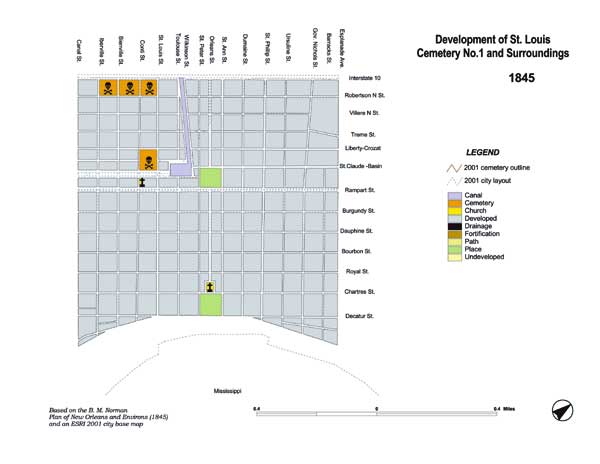
By the middle of the nineteenth century, the cemetery had become increasingly urban as the ground cover present in Latrobe’s 1834 watercolor gave way to rapid development of the cemetery accompanying the epidemics of the mid to late nineteenth century. The loss of the cemetery’s pastoral quality led to an increased allocation of the purchased tomb area to be used to endow the tomb with its own landscape setting, often distilled to the symbolic placement of a few plants, a shrub, or even plant cuttings attached to the tomb itself.
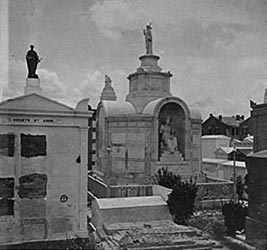
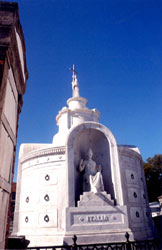
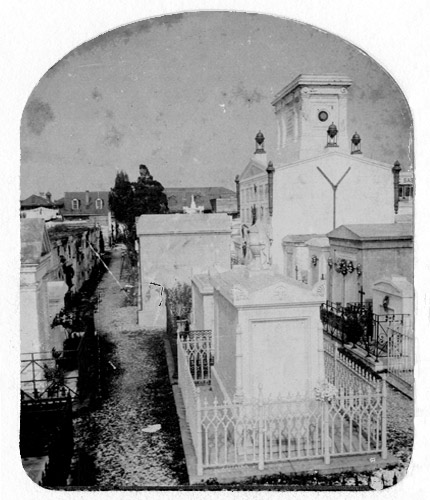
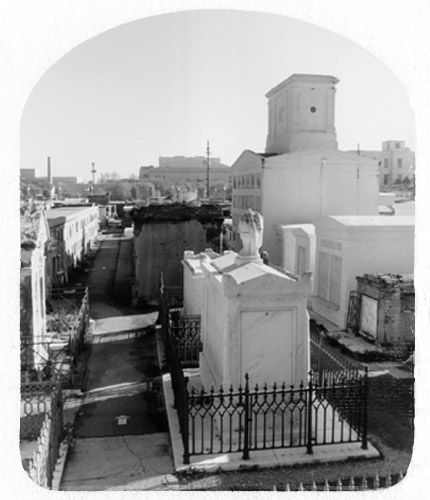
The memorial function of the cemetery’s tombscape gives it a context of a unique character, reflecting an approach to design that, in addition to its practical functions, seeks to order the incomprehensible phenomenon of death. The reasoned application of classical decorative modes and orthogonal path planning has become disoriented, resulting in the tombscape, a dynamic jumble of form, space, and context. The east facade of the Italian Society Tomb and the Conti Alley Tombscape are examples showing the variety in St. Louis Cemetery No. 1 tombscapes in past and current images. Also, see Alley 9L Tombscape restoration work.
Defined by the presence of the Italian Society Tomb façade and a perimeter of surrounding tombs that are over three tiers height, for a feeling of enclosure and spatial definition. The area takes on the quality of a formal plaza.
Italian Society Tomb
Conti Tombscape
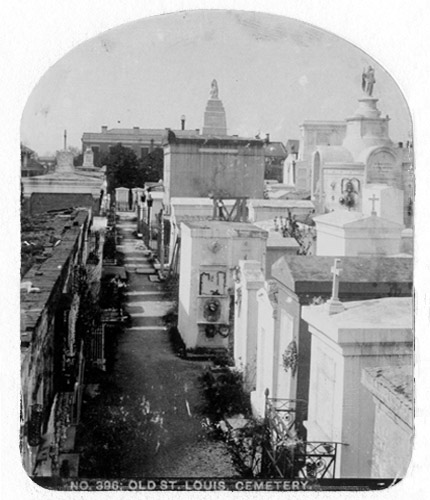
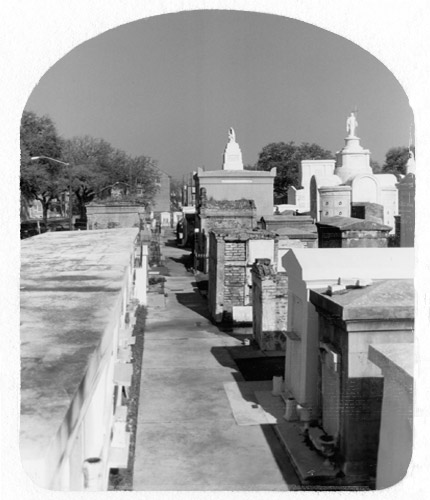
By Joseph P. Mattera, 2001.
Alley 9-L
Traditions
Historically, maintenance occurred yearly during All Saints’ Day when families cleaned, repaired, and limewashed their tombs. This yearly attention kept the tombs well sealed and protected the interior structure from the aggressive New Orleans environment.
The many family and society tombs that dominate the cemetery today indicate the tremendous wealth and power New Orleans attained by the mid nineteenth century. Like its urban counterpart, many of the early single vault tombs were expanded with additions to become multiple vault family tombs to allow for repeated burials in a place of decidedly limited space.
As families grew larger, and as the almost yearly outbreaks of yellow fever caused many deaths, the family tomb was often not large enough, or available. Space could be rented in the surrounding wall vaults until a family vault was free. There is also abundant physical evidence that families expanded their tombs over time. As need for space grew, more vaults could be added and the tomb could expand upward on the same plot.
By the end of the nineteenth century, St. Louis Cemetery No. 1 had fallen out of use from overcrowding and the public’s preference for more fashionable cemeteries on the outskirts of the city. As interment activity declined, so did visitation and yearly family maintenance activities that were so crucial to the upkeep of the tombs.
Metalwork through Time
Metalwork in St. Louis Cemetery No. 1 was used for both decorative elements such as applied relief sculpture and urns as well as architectural components such as partial and full enclosures with gates. The earliest metalworking technology in New Orleans was the hand forging of wrought iron originally brought by the French.
Transitional composite metalwork is the most prevalent type of metalwork found in the cemetery, produced roughly between 1830 and 1860. It was used exclusively to fabricate enclosure railings and relies on the combination of wrought iron and cast zinc with some cast lead and cast iron details.
Cast iron is an alloy of iron with a high (2-4%) carbon content which can be poured in a molten state into sand molds. It is hard but also brittle and is the product of an industrial process involving many professions and trades. Cast iron appears to have made its appearance in New Orleans around 1850, much of it shipped from the North with some produced locally in the foundries that primarily made machinery for the sugar refining industry. By the 1850s, cast iron panels were taking the place of fabricated work, first mounted in wrought iron frames.
Tourism
Anthropological studies often focus on the negative consequences that local, or host, communities experience from tourism, and tourism has been long criticized by the preservation community. “The tourist, many claim, erodes cultural sites, trivializes their significance, fosters theatrical reconstructions, perverts local culture and treats heritage as a consumer good.”1 These claims can be true, but the blame is not well placed. Tourism, per se, should not be considered the culprit. Poor management, or worse, the complete lack of management of the tourism component of an important cultural site, is the real problem.
“Good management of cultural tourism is central to the mission of the conservation community.”2 Sites that present mankind’s cultural heritage, whether at the very small local level or at the World Heritage Site level, should be available to the public for both learning and enjoyment. Our responsibility is to manage that public interaction so that the site is preserved and can continue to provide learning and enjoyment for many generations. We should also strive to manage the interpretations of such sites so that the local community’s past and present use of the site is respected and truthfully represented.
Converting an unknown cultural resource into a heritage tourism site is often the single most effective way to save the resource from destruction. “Heritage organizations ensure that places and practices in danger of disappearing, because they are no longer occupied or functioning or valued, will survive. It does this by adding the value of pastness, exhibition, difference, and where possible, indigeneity.”3 The tourism industry then makes the attraction economically viable as an exhibit of itself.
Growth in cultural tourism and the heritage industry can open up a variety of opportunities for conservation. “From small town arts councils to state economic development agencies to the National Trust for Historic Preservation and the National Park Service, one finds optimism that heritage tourism can stimulate economic growth and enhance quality of life to help moribund communities attract new business and industry.”4 Heritage sites can be exported to the world through tourism. Unlike other export industries, tourism does not export goods for consumption elsewhere, but imports visitors to consume the goods and services locally, with the ability to provide economic and development benefits to the greater community beyond the heritage site.5
Cultural tourism should be a powerful tool for the conservation community, and yet there exists serious concern that this tool cannot be controlled. The tourism process at a heritage site often does not occur with the guiding hand and input of the history and preservation professionals. It should be remembered that commercializing the local culture does not require the consent of the participants; it can be done by anyone. If there are obvious aspects about a site or location that can be profitably marketed to outsiders, enterprising members of the tourism industry will do so, as will others involved in the publication of books, movies, and information on the Internet. “Once set in motion, the process seems irreversible and its very subtlety prevents the affected people from taking any clear-cut action to stop it.”6 This is a key concept for the conservation community to understand, as it becomes most difficult to gain control of the tourism component of a site after the process has spread out into multiple directions.
- ICOMOS, “Letter from the Executive Director,” The ICOMOS International Committee on Cultural Tourism Newsletter, Special Edition (November/December, 1996), p. 3.
- Ibid, p. 3.
- Barbara Kirshenblatt-Gimblett, “Theorizing Heritage,” from Ethnomusicology: Journal of the Society for Ethnomusicology, Vol. 39, No. 1, Winter 1995, p. 370.
- Benita J Howell, “Weighing the Risks and Rewards of Involvement in Cultural Conservation and Heritage Tourism,” Human Organization, Vol. 53, No. 2, 1994, p. 150.
- Barbara Kirshenblatt-Gimblett, “Theorizing Heritage,” Ethnomusicology: Journal of the Society for Ethnomusicology, Vol. 39, No. 1, Winter 1995, p. 373.
- D. J. Greenwood, “Culture by the Pound: An Anthropological Perspective on Tourism as Cultural Commoditization,” Host and Guest, V. L. Smith, ed. (Philadelphia: University of Pennsylvania Press, 1989), p. 180.
The Experience
Travelers’ accounts dating from the earliest years of the nineteenth century, and continuing through to the present day, reference the New Orleans’ “cities of the dead” as curiosities not to be missed on a visit to New Orleans. Even arm-chair travelers of the nineteenth century could visit one of these other-worldly places through the many travel accounts in publications such as the Daily Advertiser (1802), Scribner’s Monthly Magazine (1873), and various Harper’s Weekly articles and sketches dating from the 1860s through the early 1900s.
Unlike other nineteenth century cemeteries located elsewhere in the United States, St. Louis Cemetery No.1 truly resembles a dense miniature city. With structures of varying styles and sizes, housing all classes, races, and ethnicities representing New Orleans society, St. Louis Cemetery No. 1 is a tangible record of a continuously developing cultural history. The existing landscape of tomb styles, types, and sizes is a landscape that tourists of the past would still recognize. Accounts dating back to the earliest years of the cemetery’s visitation describe the mixture of rich, well-kept, limewashed tombs with unkempt monuments and ruins. This contrasting picture of richness and decay is part of the historical significance of the landscape.1
In the early 1800s, travelers sought out the cemetery to enjoy a sublime and foreign experience. Upon entering the wrought-iron gates and passing through the “tortuous paths,” visitors allowed the visual experience of the place to stimulate emotion and reflect on life, death, and mortality – common themes of romanticism in the nineteenth century. Later visitors came to see this unique cemetery to view the “sepulchral houses” of the famous and infamous of New Orleans. Today, the cemetery is still a major tourist draw, and cemetery tours are a key element for the total New Orleans experience.2 Many visitors are drawn by the architectural and historical content of the cemetery, while others come for the modern intrigue of voodoo, vampires, ghosts, and the sensationalism created by fictional accounts in popular books and movies.3
Historically, the cemetery was visited because of its unusual appearance and emotive qualities. It evoked a sense of melancholy and nostalgia with its maze of paths, decaying brick tombs and unusual epitaphs. Today, architecture, intrigue, history, and memory draw the modern tourist to this place. Whether it is through one of the many organized tours, or through individual discovery, each visitor who walks through the iron gates of St. Louis Cemetery No. 1 is cast into a world separate and unlike their own.
- Selected visitor comments can be found in the following: David Lee Sterling, “New Orleans, 1801: An Account by John Pintard,” Louisiana Historical Quarterly Vol 34 no 3 (July 1951): 230; Samuel Wilson, Jr. ed., Impressions Respecting New Orleans by Benjamin Henry Boneval Latrobe: Diary & Sketches 1818-1820, (New York: Columbia University Press, 1951), 82; Edward C. Carter II, John C. Van Horne, and Lee W. Formwalt, eds. Samuel Wilson, Jr. Consulting Ed. The Journals of Benjamin Henry Latrobe 1799-1820 From Philadelphia to New Orleans, (New Haven: Yale University Press for The Maryland Historical Society, 1980), 241; Timothy Flint, Recollections of the last ten years, passed in occasional residences and journeyings in the valley of the Mississippi, (1826 reprint, New York: Johnson Reprint Corp., 1968), 225; Cyril Thornton, Men and Manners in America, 2nd ed. vol. II (Edinburgh: William Blackwood, 1834), 215; Joseph Holt Ingraham, The South – West By a Yankee, vol. 1 (New York: Harper & Brothers, 1835), 145,154-55; H. Didimus, New Orleans As I Found It (New York: Harper & Brothers, 1845); Lady Emmeline Stuart Wortley, Travels in the United States etc. During 1848 and 1850 (New York: Harper & Brothers, Publishers, 1851), 126; Sir Charles Lyell, A second visit to the United States of North America, New York: Harper and Bros, Pub. 1849, Vol II p. 96; A. Oakey Hall, The Manhattaner in New Orleans or, Phases of “Crescent City” Life. 1851. Reprint for the Louisiana American Revolution Bicentennial Commission, Baton Rouge: Louisiana State University Press, 1976; Fredrika Bremer, The Homes of the New World; Impressions of America, trans. Mary Howett (New York: Harper and Brothers, 1854), 214; Louis M. Hacker, ed. Mark Twain, Life on the Mississippi, (New York: Sagamore Press, Inc., 1957), 223.
- 2. At least 7 different tour companies are registered with the Archdiocesan Cemeteries to be able to conduct tours through St. Louis Cemetery No. 1 and hundreds of tourist visit the cemetery daily.
- 3. Many of the Anne Rice novels feature the New Orleans cemeteries and Easy Rider and Double Jeopardy are well known films with scenes in St. Louis Cemetery No. 1 and Lafayette No. 1 respectively.